Craft notes · Layered lacquer
Eggshell inlay: a mosaic in lacquer
How duck eggshell is broken into wet lacquer, filled and polished flat, and what is known about where the technique began.
· 4 min read

Eggshell inlay (蛋壳镶嵌) sets small pieces of eggshell into lacquer to make a mosaic: pale fragments separated by fine lines of colour. The surface is then filled and polished flat, so what looks like a cracked texture is smooth to the touch. Two of our lacquer pieces are finished this way, both in duck eggshell over a carved sandalwood core.
What eggshell inlay is
Clean shell is pressed into wet lacquer, where it breaks into small pieces that stay where they fall. The gaps between the pieces are filled with more lacquer, and the whole surface is built up and polished until shell and lacquer lie level.
The finished effect sits somewhere between a mosaic and a crackle glaze. From a distance it reads as a pale surface with a fine network of lines. Close up, each fragment has its own edge and its own slight difference in tone.
Eggshell inlay is a decorative technique within lacquer craft rather than a separate craft. It is not listed on its own on China's heritage lists; lacquer craft is, region by region.
Once polished, the shell is held and protected by the lacquer around it, so an eggshell piece needs the same care as any other lacquer piece: keep it dry, keep it out of strong sun, and wipe it with a soft dry cloth.
Why duck eggshell
Lacquer makers who work with eggshell choose the shell for its colour and thickness. Duck eggshell is thicker, darker and more translucent than hen's eggshell, so the colour of the lacquer beneath it shows through and warms it. Hen eggshell is white or brown. Quail shell is thinner and is used for fine detail.
Some makers also toast the shell before use, which gives tones from ivory through caramel to dark brown. Our supplier's listings say duck eggshell and do not say whether it has been toasted, so we make no claim either way. The listing for the long black leaf earrings describes fragments "in ivory and soft amber tones", and that is how we describe them.
No two shells break the same way, so no two eggshell pieces can match.
How it is done
In the traditional process the work goes in stages:
- Cleaning the shell. The shell is washed and the thin membrane inside it is removed.
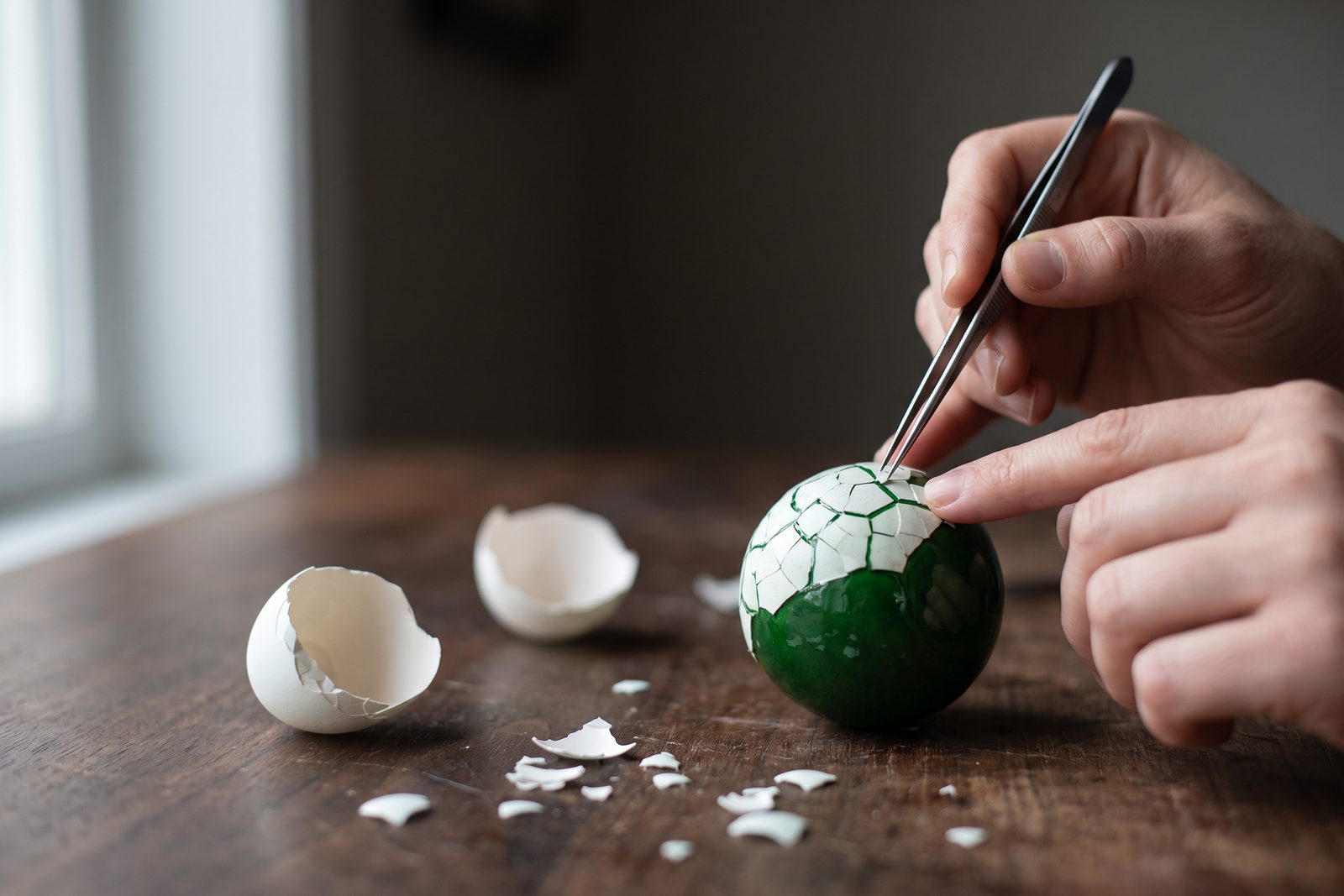
- Setting the shell. Pieces of shell are pressed into a coat of wet lacquer, where they crack into a fine mosaic. On a small curved surface such as an earring, fragments can also be laid one by one.
- Filling. Once the lacquer holding the shell has cured, the gaps between the fragments are filled with lacquer and cured again.
- Polishing flat. The surface is built up and polished back until shell and lacquer are level and smooth.
The lines between the pieces
The lines between the fragments are lacquer, so their colour is the colour of the ground. On a green piece the network is green; on a black piece it is black. The same colour also shows faintly through the shell itself, because duck eggshell lets some light pass.
The maker also decides how close the fragments sit. Packed tightly, they read almost as a solid pale surface. Spread out, they read as flecks on a dark ground. One of our pieces uses both: the fragments gather closely towards the centre of each leaf and thin out towards the points.
Because the break of each shell cannot be planned, the pattern on one earring of a pair will not repeat on the other. The colour, size and overall density are matched; the mosaic is not.
What we know about its history
Where eggshell inlay began is not settled. A Chinese article on lacquer technique calls it a technique "added in modern times". Western sources credit Vietnam, Japan or China at different points, and we do not repeat claims of a much older origin.
Some of its history is well documented. Eggshell inlay is one of the ways lacquer makers in China and Vietnam add texture; in 1920s Paris Jean Dunand made it famous. Dunand had learned lacquer from the Japanese artist Seizo Sugawara from about 1912, and from about 1925 his eggshell lacquer, coquille d'œuf, made with hen, duck and partridge shell, became one of the signatures of Art Deco design.
In Vietnam, lacquer painting took up eggshell inlay strongly from the 1930s. In China, lacquer workshops in Chongqing exported eggshell-inlaid pieces in the 1950s and 1960s.
In our pieces
Both of our eggshell pieces are natural lacquer over a carved sandalwood core, with duck eggshell set into the lacquer and polished smooth.
- The Green Eggshell Lacquer Sphere Earrings: a round sphere covered in white duck eggshell set into deep green lacquer, with fine green lines between the pieces and the odd warm fleck where the shell has its own colour. It hangs below an openwork 18k gold flower bead on a 14k gold ear hook. About 2 × 5.5 cm and listed at about 18.7 g, it is the heaviest lacquer earring in the collection.
- The Long Black Lacquer Eggshell Leaf Earrings: a long, slender leaf of deep black lacquer, scattered with duck eggshell in ivory and soft amber tones, on gold-tone ball post studs. About 1 × 5.5 cm and listed at about 4.3 g.


Every piece is handcrafted to order and leaves us in about 10 days. It is made by hand in China, and its mosaic is its own.


