Craft notes · Layered lacquer
Gold leaf in lacquer
How gold is beaten into leaf, the ways Chinese lacquer uses it, and what we can and cannot tell you about the gold in our pieces.
· 5 min read

Gold leaf (金箔, jinbo) is gold beaten into a film thinner than a micrometre, a thousandth of a millimetre. Chinese lacquer has used it in several ways: laid on, painted with, set into engraved lines, or sealed under a clear coat so that it glows from below. Many of the lacquer pieces in our collection carry gold leaf, from a fine shimmer across a whole sphere to a few broken flakes on a dark ground.
What gold leaf is
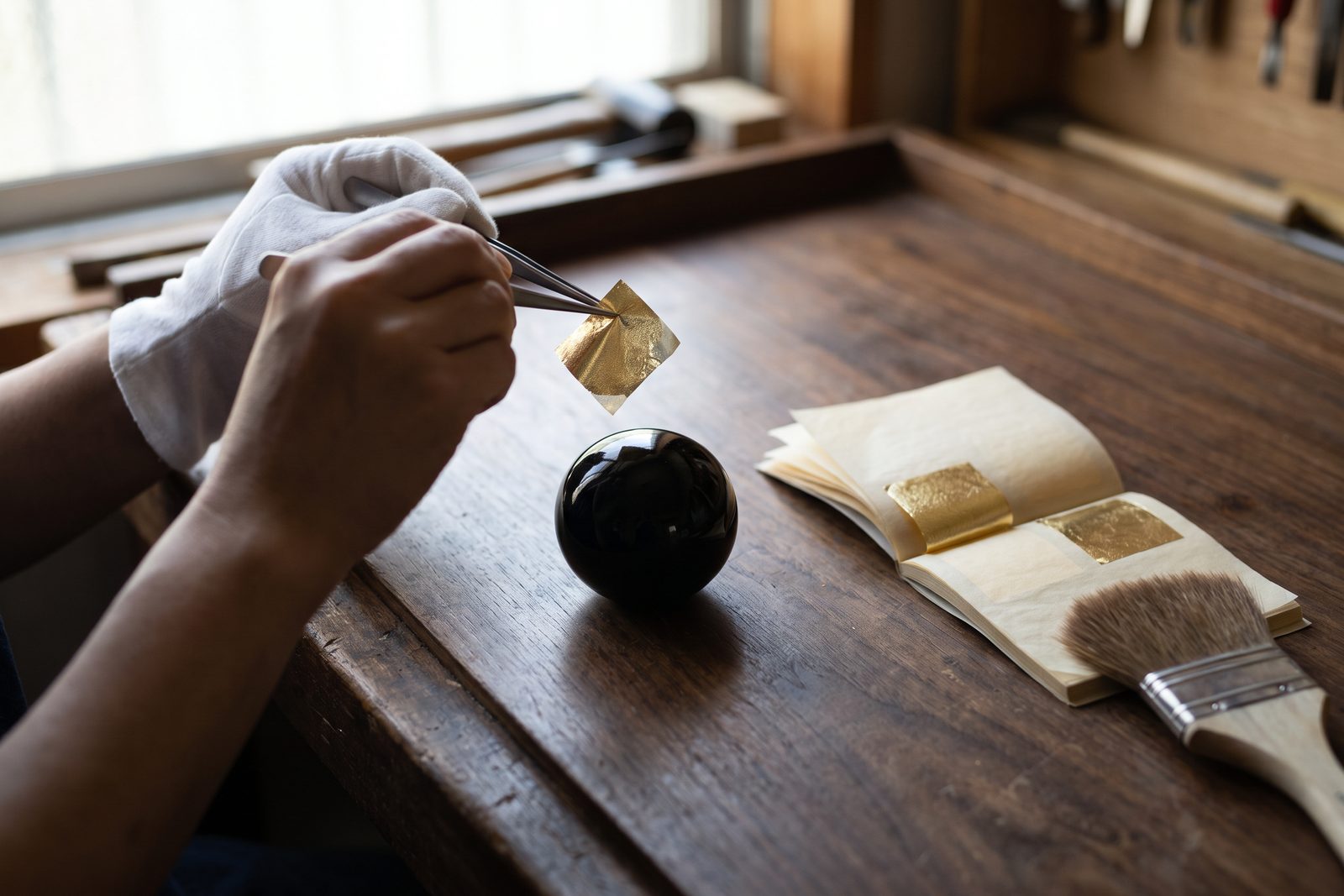
Leaf this thin cannot hold its own shape. It has to be laid onto something that will grip it, and in Chinese lacquer that something is lacquer itself: a coat brushed on and left until it is tacky, so the gold sticks where it touches.
Once it is down, the leaf takes the colour and texture of what is under it. Laid over a smooth, glossy ground it looks like an unbroken gold surface. Laid unevenly, or allowed to crease and break as it is pressed over a curve, it lets the dark lacquer show through in patches and lines. Both effects appear in our pieces.
Nanjing and the black gold paper
China's best-known gold beating tradition is in Nanjing. The craft there is dated to the Eastern Jin dynasty in the 4th century CE, more than 1,700 years ago.
The gold is beaten between sheets of a special black paper, wujinzhi (乌金纸, "black gold paper"), over many thousands of hammer strokes, until it is about 0.1–0.12 micrometres thick. That is roughly a ten-thousandth of a millimetre.
Nanjing gold leaf beating (南京金箔锻制技艺) has been on China's national list of intangible cultural heritage since the first round in 2006. Two notes for accuracy. UNESCO's 2009 inscription for Nanjing is Yunjin brocade, a woven silk, not gold leaf. And our supplier does not say where the leaf in our pieces comes from, so we do not claim that it is Nanjing leaf.
The hooks are 14k gold and the coin flowers are 18k. We do not give a karat for the leaf, because our supplier does not state one.
How lacquer uses gold
Chinese lacquer has names for the different ways gold goes into a surface. These are the ones most often described:
- Tiejin (贴金), gilding
- Cut gold leaf laid onto a tacky gold size made of lacquer.
- Miaojin (描金), gold painting
- A design painted in lacquer, then covered with gold leaf or gold powder, which holds only where the lacquer was painted.
- Qiangjin (戗金), engraved gold
- Fine lines engraved into cured lacquer and filled with gold.
- Zhaojin (罩金), gold under a clear coat
- Gold covered with a transparent lacquer, so it glows from underneath and is protected from wear.
Our supplier's listings describe laid leaf, not engraved lines or painted designs. On some it lies on or near the surface; on others it sits under a clear coat.
Laying the leaf
In the traditional process, gilding a lacquered object runs like this:
- Preparing the ground. The object is lacquered and cured to a smooth surface.
- Applying the size. A thin coat of lacquer is brushed where the gold should go and left until it is tacky.
- Laying the leaf. Leaf is cut and laid onto the tacky lacquer and pressed down. Over a curve it can crease and break, leaving fine lines and patches.
- Curing. The piece goes back into warm, humid air so that the lacquer under the leaf hardens and grips it.
- Covering, where wanted. For gold under a clear coat, transparent lacquer is brushed over the leaf and cured in turn.
What we can tell you about our gold
Gold in jewellery raises fair questions about purity, and we answer them as far as our supplier's information allows.
- Hooks and findings on every lacquer piece are 14k gold.
- The coin-flower charms on the Black Xipi Lacquer Sphere and Coin Earrings, the Red Xipi Lacquer Coin Charm Hook Earrings and the Gold-Marbled Red Lacquer Coin Stud Earrings are 18k gold, as is the openwork flower bead on the Green Eggshell Lacquer Sphere Earrings.
- The leaf is set in the lacquer, on or under the surface depending on the piece. On the Small Gold Leaf Lacquer Ball Stud Earrings it sits under clear lacquer. On several black pieces the listings describe some of the leaf as pale or silvery in tone.
We do not give a karat for the leaf. The supplier does not state one. Other parts, such as stud tops and small charms, are described on each product page as gold-tone, and we do not give those a karat either.
The coin flower
Several pieces carry a small coin-flower in 18k gold, after the round, square-holed coins that became a pattern for good fortune in China.
Chinese cash coins were round with a square hole in the centre, and the shape became a decorative pattern of its own. It is also read as "round heaven, square earth" (天圆地方). When coin circles are drawn overlapping in a row, the overlaps form four-petalled shapes, which is the likely source of the name coin flower (铜钱花).
We give the motif for its history and its shape. We make no claim that it brings anything to the person who wears it.
In our pieces
Every gold leaf piece we sell is natural lacquer over a carved sandalwood core, with 14k gold findings. Four that show different ways the leaf can sit:
- The Gold Leaf Lacquer Sphere Filigree Drop Earrings: a round sphere covered in gold leaf laid unevenly, so dark lacquer shows through in soft patches, below an openwork filigree flower set with small clear stones.
- The Dark Gold-Leaf Lacquer Bellflower Drop Earrings: very dark brown lacquer scattered with gold leaf from fine specks to broken patches, above a fluted gold-tone bellflower that moves as you wear it.
- The Black Lacquer Gold-Flake Bar Drop Earrings: a narrow bar of near-black lacquer, about 0.5 × 6 cm and listed at about 2.8 g, with flakes of leaf that gather more thickly towards the lower end. The two bars of a pair are not identical.
- The Black Gold-Leaf Oval Lacquer Chain Earrings: a flat black oval with flakes of gold and silver-toned leaf, on a long fine chain below a 14k gold ball stud. About 1.2 × 6 cm.


Every piece is handcrafted to order and leaves us in about 10 days. It is made by hand in China, and the leaf falls a little differently on each one.


